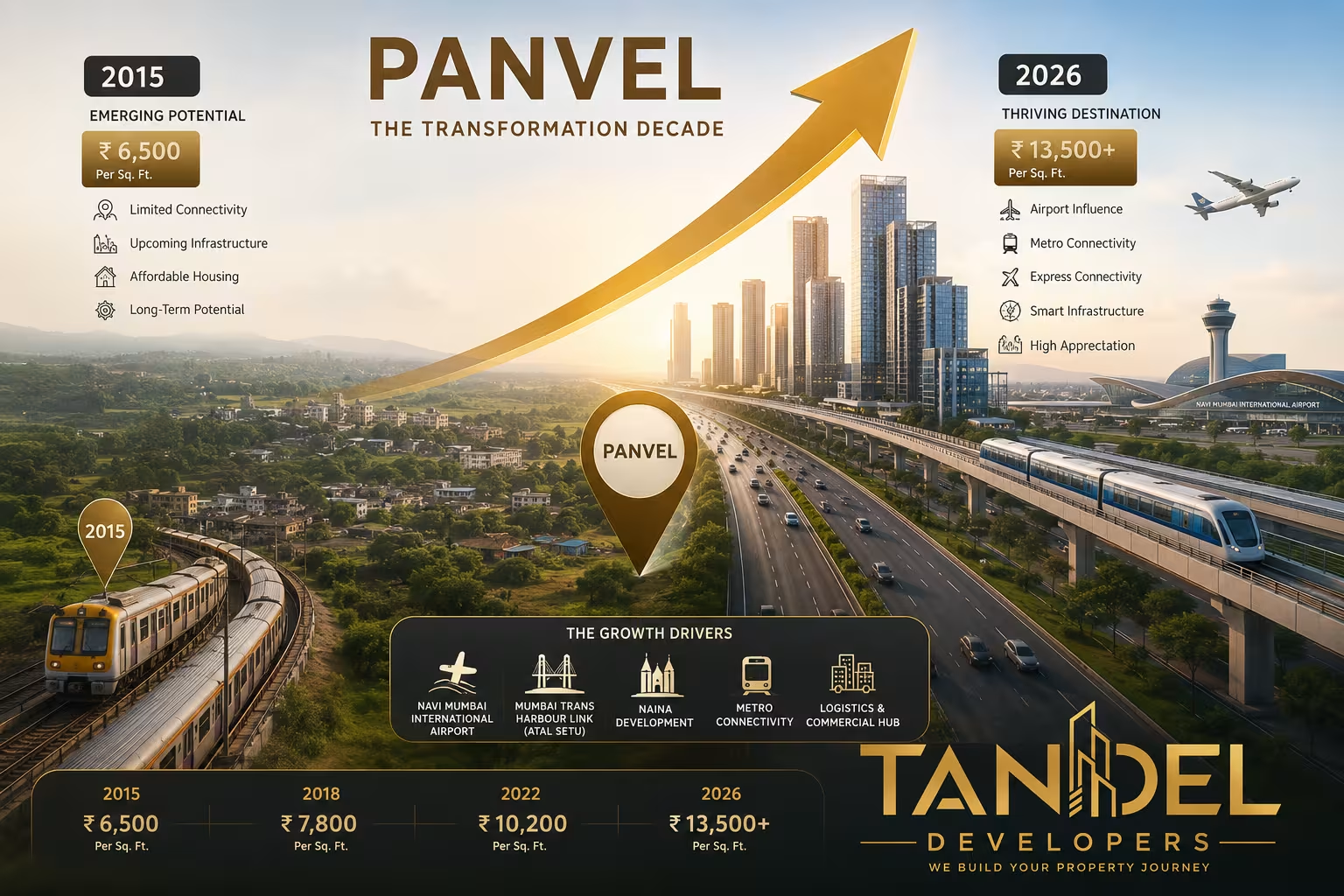
Panvel Real Estate Growth has transformed the region from an overlooked suburb into one of Maharashtra’s fastest-growing property markets. In 2015, Panvel was often viewed as the far edge of the Mumbai Metropolitan Region. While local residents understood its strategic importance, many homebuyers and investors considered it too far from Mumbai’s commercial centers.
Fast forward to 2026, and the narrative has changed dramatically.
Panvel is no longer discussed as a distant suburb. It is increasingly being referred to as the gateway to Navi Mumbai’s next phase of growth. The arrival of mega infrastructure projects such as the Navi Mumbai International Airport, Mumbai Trans Harbour Link (Atal Setu), NAINA development plans, metro connectivity, and logistics corridors has completely transformed investor perception and property values. Recent market reports indicate that average property prices in Panvel have more than doubled since 2015, making it one of the strongest-performing real estate markets in the Mumbai Metropolitan Region.
This case study examines how Panvel evolved between 2015 and 2026, what drove property appreciation, and what lessons investors can learn from one of Maharashtra’s most remarkable real estate growth stories.
Panvel in 2015: A Market Driven by Potential Rather Than Demand
To understand Panvel’s growth, it is important to revisit the market conditions that existed in 2015.
At that time, Panvel was primarily known as a transportation junction connecting Mumbai, Pune, and Raigad. Property prices were relatively affordable compared to central Navi Mumbai locations. Average residential rates in many parts of Panvel ranged between ₹6,000 and ₹7,000 per square foot, making it attractive mainly to budget-conscious buyers and long-term investors.
However, affordability alone does not create appreciation.
What attracted forward-looking investors was a series of proposed infrastructure projects that had the potential to reshape the region. The Navi Mumbai International Airport had already been announced. Discussions around NAINA (Navi Mumbai Airport Influence Notified Area) were gaining momentum. Connectivity plans were expanding.
Most of these projects existed only on paper, but smart investors understood a fundamental rule of real estate:
The biggest returns often come before infrastructure becomes operational.
The First Growth Wave: 2015–2018
Between 2015 and 2018, Panvel entered its first appreciation cycle.
During this period, property values grew steadily rather than dramatically. Market confidence improved as airport-related planning advanced and developers began acquiring land for future projects. Buyers who were willing to take calculated risks started entering the market.
Average property rates increased from approximately ₹6,500 per square foot in 2015 to nearly ₹7,800 per square foot by 2018. While this growth was not explosive, it demonstrated that investor confidence was strengthening.
The market was no longer driven by speculation alone. Buyers were beginning to believe that Panvel’s transformation would eventually become reality.
Case Study: The Investor Who Bought Before the Boom
One of the most interesting observations about Panvel’s growth comes from early investors who entered the market before infrastructure execution began.
A discussion shared by a Navi Mumbai property owner highlights a common experience. The family purchased a flat in Panvel in 2015 when many people questioned the decision. At the time, critics pointed to weak connectivity, limited development, and the perception that Panvel was too far from Mumbai. However, the buyer focused on long-term infrastructure projects rather than current conditions. By 2026, attitudes had completely changed, and many of those same critics were exploring investment opportunities in the area.
While this is only one example, it reflects a broader market trend. The highest returns often accrue to investors who recognize growth corridors before they become mainstream.
The Infrastructure Effect: Why Panvel Changed So Quickly
Real estate appreciation is rarely accidental.
When analysts study successful property markets, they usually discover one common factor: infrastructure.
Panvel benefited from an unusually powerful combination of infrastructure catalysts.
Navi Mumbai International Airport
The airport became the defining growth story for the region.
Unlike traditional infrastructure projects that primarily improve transportation, airports create entire economic ecosystems. Residential demand increases as aviation, hospitality, logistics, retail, and commercial activities expand around the airport zone. Recent market analysis indicates that airport-led development has become one of the strongest drivers of residential demand across Panvel and surrounding regions.
Mumbai Trans Harbour Link (Atal Setu)
The opening of Atal Setu significantly improved connectivity between Mumbai and Navi Mumbai.
Travel times reduced substantially, making Panvel more accessible to professionals, investors, and businesses. This improved accessibility contributed directly to higher buyer interest and stronger property demand.
NAINA Development
NAINA transformed the long-term planning framework of the region.
The initiative encouraged organized urban development around the airport influence zone, attracting developers, infrastructure investments, and institutional interest.
Metro Connectivity
The expansion of metro infrastructure further strengthened Panvel’s appeal.
For modern homebuyers, connectivity has become one of the most important decision-making factors. Improved mobility translates directly into stronger residential demand and higher property valuations.
The Second Growth Wave: 2019–2022
The years between 2019 and 2022 marked an important transition period.
The market was no longer driven solely by future expectations. Infrastructure projects were becoming visible on the ground. Construction activity increased. Developers launched larger projects. Institutional confidence strengthened.
Despite temporary disruptions caused by the pandemic, Panvel demonstrated resilience.
Average property prices moved from approximately ₹8,200 per square foot in 2020 to around ₹10,500 per square foot by 2022. This growth reflected increasing confidence that the region’s infrastructure vision would eventually materialize.
More importantly, end-users began entering the market alongside investors.
This shift is critical because sustainable real estate growth requires genuine residential demand rather than pure speculation.
The Breakout Phase: 2022–2026
If the period between 2015 and 2022 laid the foundation, the years from 2022 to 2026 delivered the breakout.
Multiple reports indicate that residential property prices in Panvel appreciated by more than 50% within a relatively short period. Average rates climbed from approximately ₹8,800 per square foot in late 2022 to nearly ₹13,500 per square foot by the end of 2025. Some micro-markets experienced even stronger appreciation.
This acceleration occurred because several infrastructure projects moved from promise to reality.
For many years, buyers were investing in expectations.
By 2025 and 2026, they were investing in visible infrastructure.
The difference between these two stages often creates the most significant appreciation cycle in any real estate market.
A Data-Driven Look at Property Appreciation
The numbers reveal the scale of Panvel’s transformation (property appreciation)
Average property rates increased from roughly ₹6,500 per square foot in 2015 to approximately ₹13,800 per square foot in 2026. This represents more than a 100% increase over eleven years.
Several micro-markets delivered even stronger performance.
Areas such as Karanjade, airport influence zones, and emerging growth corridors experienced appreciation levels significantly higher than the overall market average. Certain locations recorded four to five times growth compared to their 2015 valuation levels.
These figures demonstrate why Panvel has become one of the most closely watched real estate markets in Maharashtra.
What Today’s Buyers Can Learn From This Case Study
One of the most valuable lessons from Panvel’s journey is that infrastructure creates opportunity long before it creates convenience.
Many investors wait until infrastructure is fully operational before entering a market. By that stage, a substantial portion of appreciation has often already occurred.
The Panvel case study demonstrates the importance of identifying future growth corridors early. Investors who recognized the significance of the airport, NAINA, and regional connectivity plans before the broader market did were rewarded with significant capital appreciation.
Another important lesson is that successful investing requires patience.
The period between 2015 and 2020 did not produce overnight returns. Appreciation occurred gradually. Investors who remained focused on long-term fundamentals benefited the most from the eventual transformation.
Is Panvel’s Growth Story Over?
This is perhaps the most common question among current buyers.
The answer depends on perspective.
The explosive appreciation associated with early infrastructure announcements may not be repeated at the same pace. However, Panvel is still evolving.
The airport ecosystem is expanding. Commercial activity continues to grow. Logistics infrastructure is strengthening. New employment opportunities are emerging. Urban development plans are progressing. Recent market reports suggest that Panvel remains one of the strongest long-term growth corridors within the Mumbai Metropolitan Region.
Rather than asking whether growth is over, investors may find greater value in identifying which micro-markets within Panvel are positioned for the next phase of appreciation.
Conclusion
The story of Panvel between 2015 and 2026 is more than a story about rising property prices.
It is a case study in how infrastructure, vision, and long-term planning can transform an entire region.
What was once viewed as a peripheral market has evolved into one of Maharashtra’s most important real estate destinations. Property values have more than doubled, investor confidence has strengthened, and large-scale infrastructure projects have fundamentally altered the region’s trajectory.
For homebuyers, the Panvel story demonstrates the importance of looking beyond current conditions and evaluating future growth drivers. For investors, it reinforces a timeless real estate principle:
The greatest opportunities often emerge where infrastructure and vision intersect.
As Panvel enters its next chapter, one thing is clear,the transformation that began in 2015 has permanently changed the region’s real estate landscape, and its impact will continue to shape investment decisions for years to come.
Frequently Asked Questions (FAQs)
Why has Panvel become a popular real estate destination?
Panvel has emerged as one of the fastest-growing real estate markets in the Mumbai Metropolitan Region due to major infrastructure projects such as the Navi Mumbai International Airport, Mumbai Trans Harbour Link (Atal Setu), metro connectivity, and the NAINA development plan. These projects have significantly improved connectivity, employment opportunities, and investment potential.
How much have property prices appreciated in Panvel between 2015 and 2026?
Property prices in Panvel have witnessed significant appreciation between 2015 and 2026. In many locations, average property rates have more than doubled during this period, making Panvel one of the strongest-performing real estate markets in Maharashtra.
Is Panvel a good location for real estate investment in 2026?
Yes, Panvel continues to attract both homebuyers and investors due to its strategic location, improving infrastructure, and long-term growth prospects. While early investors have already benefited from substantial appreciation, several emerging micro-markets within Panvel still offer investment opportunities.
What are the main factors driving Panvel real estate growth?
The key factors driving Panvel real estate growth include:
Navi Mumbai International Airport
Mumbai Trans Harbour Link (Atal Setu)
NAINA development project
Metro connectivity
Growing commercial and logistics hubs
Together, these developments have increased demand for residential and commercial properties across Panvel.
Which areas in Panvel have shown the highest property appreciation?
Several micro-markets within Panvel have experienced strong appreciation over the last decade. Areas located near airport influence zones, major infrastructure corridors, and rapidly developing residential clusters have generally recorded higher growth compared to the broader market.
Is Panvel better for end-users or investors?
Panvel offers opportunities for both end-users and investors. Homebuyers benefit from improved connectivity, modern residential developments, and future infrastructure growth, while investors are attracted by the area’s long-term appreciation potential and increasing demand.
How does the Navi Mumbai International Airport impact property prices in Panvel?
The Navi Mumbai International Airport is expected to create significant economic activity in the region, including growth in aviation, hospitality, retail, logistics, and commercial sectors. Historically, airport-led development has contributed to higher property demand and stronger capital appreciation in surrounding areas.
Will Panvel property prices continue to rise in the future?
While future appreciation depends on market conditions and infrastructure execution, many real estate experts believe Panvel will remain an important growth corridor within the Mumbai Metropolitan Region. Continued development of infrastructure and commercial activity could support long-term demand.
What should buyers consider before investing in Panvel real estate?
Before investing in Panvel, buyers should evaluate factors such as location, connectivity, developer reputation, project approvals, future infrastructure plans, and long-term growth potential. Researching upcoming developments can help identify areas with stronger appreciation prospects.
Why is Panvel considered one of the most promising real estate markets in Maharashtra?
Panvel combines affordability, strategic connectivity, large-scale infrastructure investments, and future urban development plans. These factors have transformed it from a peripheral market into one of Maharashtra’s most promising real estate destinations for both residential and investment purposes.