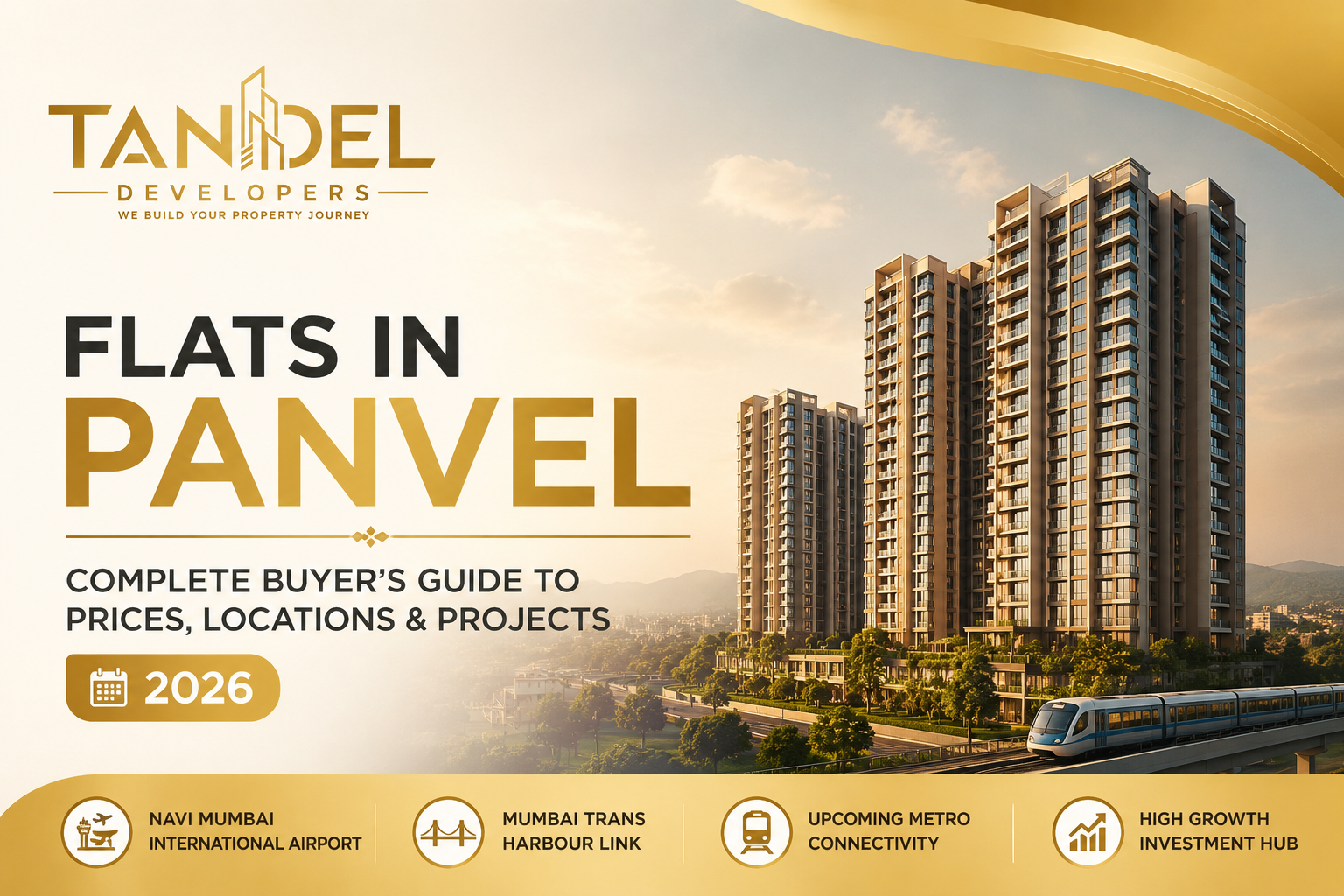
If you are looking for flats in Panvel and you want straight answers no vague promises, no sales talk you are in the right place. This guide covers everything: what flats cost today, which locations make sense for different budgets, which projects are worth your time, and what the infrastructure story really means for your money.
Panvel has gone from being a “wait and watch” market to one of the most actively discussed real estate destinations in the Mumbai Metropolitan Region. The Navi Mumbai International Airport opened on December 25, 2025. The Mumbai Trans Harbour Link (MTHL), also known as Atal Setu, is already operational. These two changes alone have shifted how buyers and investors look at this market.
Let us get into the details.
Why Panvel Is Attracting Buyers in 2026
A few years ago, the conversation around Panvel was mostly about what was coming — the airport, the sea link, the new metro lines. That conversation has now changed because most of those projects are either live or near completion.
The NMIA (Navi Mumbai International Airport) started commercial operations in December 2025, with property prices in the Panvel region jumping 74% since 2021 according to market data. That is not a projection. That has already happened. Experts are now forecasting a sustained annual appreciation of 8% to 12% over the next seven years as the airport corridor matures.
The MTHL reduces travel time from South Mumbai to Navi Mumbai from over 90 minutes to just 20 minutes. For anyone working in South Mumbai’s financial districts, Panvel has now become a realistic place to live rather than just invest. That is a genuine shift in demand.
Beyond the airport and the sea link, the Panvel Karjat Rail Corridor will improve suburban rail connectivity, and Metro Line 8 is planned to connect NMIA to South Mumbai, further reducing dependency on road travel. For a buyer thinking 5 to 10 years ahead, this infrastructure foundation is hard to find at these price points anywhere else in the MMR.
Current Flat Prices in Panvel (2026)
As of April 2026, the verified rate range for flats in Panvel sits between Rs 9,000 and Rs 14,500 per sq ft, with an average of around Rs 13,800 per sq ft. The government transaction rate recorded by MahaRERA is around Rs 10,530 per sq ft, which reflects actual stamp duty registrations.
Here is a simple breakdown of what different configurations cost:
Configuration | Price Range (Approx.) | Carpet Area (Approx.) |
1 BHK Flat | Rs 20 lakh – Rs 45 lakh | 350 – 500 sq ft |
2 BHK Flat | Rs 40 lakh – Rs 80 lakh | 600 – 900 sq ft |
2 BHK (Premium) | Rs 85 lakh – Rs 1.2 crore | 750 – 1,000 sq ft |
3 BHK Flat | Rs 90 lakh – Rs 1.8 crore | 1,000 – 1,400 sq ft |
3 BHK (Luxury) | Rs 1.5 crore – Rs 2.5 crore | 1,200 – 1,800 sq ft |
The range is wide because Panvel is not a single market. It has distinct sub-markets, each with its own price point and buyer profile. Understanding that difference is the first real step in making a good decision.
Panvel Sub-Markets: Which Location Fits Your Budget
Old Panvel is the most established part. It has good social infrastructure, markets, schools, and hospitals in place. Prices here are on the higher end of the range, usually Rs 11,000 to Rs 14,000 per sq ft. For a ready-to-move 2 BHK flat, expect to pay Rs 75 lakh and above.
New Panvel covers the sectors developed by CIDCO over the past two decades. It has a planned layout with wider roads, better parks, and cleaner infrastructure than older parts of the city. Prices sit between Rs 10,000 and Rs 13,500 per sq ft depending on the exact sector and project quality.
Pushpak Nagar is the premium end of Panvel today. Being close to the airport corridor, it commands prices of Rs 13,000 to Rs 14,500 per sq ft. A 2 BHK here will easily touch Rs 1.1 crore to Rs 1.2 crore. This is where developers are launching their flagship projects.
Kamothe borders Kharghar and gives buyers access to better social infrastructure. It falls in the Rs 9,000 to Rs 11,000 per sq ft range, making it attractive for first-time buyers. A 2 BHK flat here can still be found in the Rs 65 lakh to Rs 80 lakh range.
Panvel Fringe Areas (Bhokarpada, Vardoli, Shedung) are where pre-launch pricing and investment plays are happening. Rates sit between Rs 8,500 and Rs 10,500 per sq ft. These areas have longer possession timelines but offer the biggest potential for pre-launch value appreciation. Notable projects like Hiranandani Fortune City sit in this zone.
Here is a comparison of the key sub-markets:
Sub-Market | Rate per sq ft (Approx.) | Possession Readiness | Best For |
Old Panvel | Rs 11,000 – Rs 14,000 | Ready to move options available | End users wanting established area |
New Panvel | Rs 10,000 – Rs 13,500 | Mix of ready and under-construction | Families, long-term living |
Pushpak Nagar | Rs 13,000 – Rs 14,500 | Mostly under construction | Premium buyers, airport proximity |
Kamothe | Rs 9,000 – Rs 11,000 | Good ready-to-move supply | First-time buyers, budget buyers |
Panvel Fringe | Rs 8,500 – Rs 10,500 | Long possession horizon | Investors, pre-launch buyers |
Panvel vs Other Navi Mumbai Locations: Honest Comparison
A common question buyers ask is whether Panvel makes more sense than Kharghar, Ulwe, or even stretching to a Mumbai suburb. Here is a straightforward comparison:
Parameter | Panvel | Kharghar | Ulwe | Taloja |
Avg Rate (per sq ft) | Rs 13,800 | Rs 17,000+ | Rs 12,500 | Rs 8,500 |
5-Year Price Appreciation | 30.5% | 22% | 28% | 18% |
Airport Proximity | 15 – 20 mins | 25 – 30 mins | 10 mins | 30 mins |
MTHL Access | Good | Moderate | Good | Limited |
Social Infrastructure | Good (Old Panvel) | Excellent | Developing | Developing |
Inventory | Large | Moderate | Large | Large |
Panvel is roughly 20% cheaper than Kharghar but offers better airport proximity and stronger price growth momentum. Ulwe is slightly cheaper and even closer to the airport but has thinner social infrastructure. Taloja is the most affordable but still developing in terms of schools, hospitals, and daily convenience. For a balanced decision price, connectivity, and livability — Panvel stands out in 2026.
Top Projects to Look at in Panvel
The market has a large number of projects, but a few stand out based on RERA registration, developer track record, and buyer interest.
Hiranandani Fortune City sits in the Panvel fringe zone near Shedung. It is a large integrated township project from Hiranandani Developers. The scale of the development, combined with the brand’s reputation, makes it one of the most tracked projects in the zone. Configurations range from compact 1 BHK flats to larger 3 BHK apartments.
Paradise Sai World City is one of the highest-transaction projects in Panvel. It recorded about 73 transactions in the past year, the highest in the area according to MahaRERA data. The sheer volume of transactions is a signal of genuine demand rather than speculative interest.
Indiabulls Park Panvel spans 30 acres and offers 1, 2, 3, and 4 BHK options in the Rs 475 to Rs 1,857 sq ft carpet area range. A large project from a known developer with good amenity infrastructure.
Wadhwa Wise City is another township-format project that buyers and investors have been watching. It offers a range of configurations and is positioned within the New Panvel belt.
Millennium Infinia Panvel is a newer launch offering 1, 2, and 3 BHK apartments spread across 0.76 acres with possession expected by June 2026. Carpet areas start at 440 sq ft and go up to 1,920 sq ft for the 3 BHK.
Before you make any decision, always check that a project is RERA-registered on the MahaRERA portal. Cross-check the possession date, approved carpet area, and developer litigation history on the portal itself. Do not rely on the marketing brochure alone.
What to Check Before Buying a Flat in Panvel
The real estate market in any growing location will always have a mix of good projects and poorly managed ones. Here is what an experienced buyer typically checks before committing.
RERA Registration is the starting point. Every project in Maharashtra must be registered under MahaRERA. The registration gives you access to the possession schedule, project approvals, and the developer’s financial disclosures. Visit MahaRERA official portal and search for the project name before visiting the site.
Carpet Area vs Super Built-Up Area is where many first-time buyers get confused. Developers often quote a price based on the super built-up area, which includes corridors, staircases, and common spaces. RERA mandates pricing on carpet area. Always ask for the carpet area figure and calculate the per sq ft rate on that number alone.
Possession Timeline matters more in Panvel than in ready areas because a large number of projects are still under construction. Check the RERA possession date, then look at the construction completion percentage. A project that is 30% complete with a possession date of December 2026 is a red flag.
Developer Track Record is something you can check through past projects. Look at whether they delivered previous projects on time, what buyers of earlier projects say on forums, and whether there are any RERA complaints filed against the developer. MahaRERA complaints search allows you to check this directly.
Location Verification means visiting the site in person, not just looking at the project brochure. Drive from the project to the nearest railway station, the nearest school, the nearest hospital, and the nearest market. Do this at peak hours. The infrastructure picture on paper is strong, but actual day-to-day commute quality depends on where exactly the project sits within Panvel.
Home Loan and Registration Costs: What You Actually Pay
The flat price is not the final number. Here is a breakdown of the total cost a buyer in Maharashtra typically incurs:
Cost Component | Approximate Amount |
Stamp Duty (Maharashtra) | 5% of property value |
Registration Charges | 1% of property value (max Rs 30,000) |
GST (Under Construction) | 5% of base price |
Maintenance Deposit | Rs 50,000 – Rs 2 lakh depending on project |
Parking Charges | Rs 2 lakh – Rs 5 lakh depending on project |
Legal/Documentation Fees | Rs 10,000 – Rs 30,000 |
For a 2 BHK flat priced at Rs 65 lakh, you can estimate an additional Rs 5 to Rs 7 lakh in registration, stamp duty, and miscellaneous charges. Budget for this upfront rather than treating it as a surprise at the time of registration.
For home loans, most nationalised and private banks offer up to 80% LTV (Loan to Value) for properties in Panvel. Check HDFC Home Loan or SBI Home Loan for current interest rates and eligibility. As of early 2026, home loan rates from major banks sit in the 8.5% to 9.25% range, depending on credit score and loan tenure.
Is Panvel a Good Long-Term Investment in 2026?
The honest answer is yes, for a specific type of buyer. Panvel makes the most sense if you are buying to live in the next 3 to 5 years, or if you are an investor with a 5 to 10 year horizon who can wait out the construction and infrastructure completion timeline.
Property prices in Panvel have appreciated about 49% over the last 10 years and about 18.7% over the last three years. The 5-year appreciation sits at 24.2%. With the airport now operational and the MTHL open, the region has crossed the most uncertain phase of its development. The tailwinds from this point forward — the Aerocity development, NAINA (Navi Mumbai Airport Notified Area) urban planning, Metro Line 8, and the Panvel-Karjat corridor — are all building on infrastructure that is already in the ground rather than still on paper.
The one thing to watch is supply. Panvel has a large number of new projects launching, and oversupply in specific micro-pockets can slow appreciation in the short term even when overall demand is strong. Focus on projects in well-connected parts of New Panvel, Kamothe, or near the airport corridor where employment and footfall growth will anchor demand.
For more research on Navi Mumbai real estate trends, you can also visit 99acres Panvel page and NoBroker’s Panvel listings to compare active listings with actual transaction data from MahaRERA.
Conclusion
Panvel in 2026 is a market that has moved from speculation to substance. The airport is live. The sea link is open. Prices have already risen meaningfully, and further appreciation is expected as the full infrastructure ecosystem — metro, Aerocity, NAINA — matures over the next decade. For end-users, Kamothe and New Panvel offer the best value combination of price, readiness, and livability today. For investors, the fringe areas with township-format projects from established developers represent the stronger 5 to 7 year appreciation play. Whatever your reason for buying, do your homework on RERA compliance, actual carpet area pricing, and possession timelines before you sign anything.